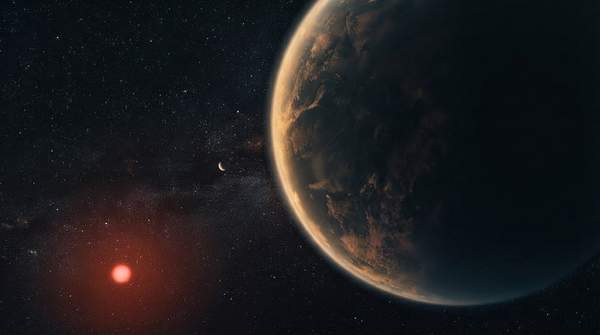
Exoplanets are usually described with familiar labels—terrestrial, super-Earth, Neptune-like, gas giant—but these descriptive terms, popularized by NASA and other outreach organizations, only loosely capture what a planet actually is. In a 2024 paper, researchers Eva Plávalová and Andrej Rosaev proposed something more rigorous: a formal classification system built on four measurable physical parameters—mass, mean orbital temperature, orbital eccentricity, and bulk density—that together produce a compact classification code for any exoplanet. Under their scheme, Earth itself becomes "EW0t": an Earth-mass planet, in the Water temperature class, on a circular orbit, with a terrestrial density. This article explains both the familiar descriptive categories and the four-parameter framework that translates them into a systematic science.
Common Exoplanet Categories: A Descriptive Overview
NASA's exoplanet portal sorts known planets into four main types: gas giant, Neptunian, super-Earth, and terrestrial. Gas giants resemble Jupiter and Saturn but are often much larger and orbit closer to their stars, with swirling gases above a solid core and no hard outer surface. Neptune-like planets are similar in size to Neptune or Uranus, typically wrapped in hydrogen- and helium-dominated atmospheres around rocky, heavy-metal cores. Super-Earths—objects with no counterpart in our solar system—fall between two and ten Earth masses yet remain smaller than Neptune, and can be made of gas, rock, or a combination of both.
The Planetary Society offers a finer-grained ordering, listing rocky planets, super-Earths, mini-Neptunes, ice giants, and gas giants from smallest to biggest. That account adds nuance NASA's four-type scheme compresses: planets in the super-Earth and mini-Neptune size range may be ocean worlds with liquid-water oceans hundreds of kilometers deep, while some rocky planets in carbon-rich systems could be ultra-dry carbon planets whose rocks pair silicon with carbon rather than oxygen. Location matters too—hot Jupiters and hot Neptunes are big, gassy planets in tight, fast orbits around their stars. These categories are intuitive, but they are descriptive rather than systematic, which is precisely the gap the formal framework addresses.