
All Stories
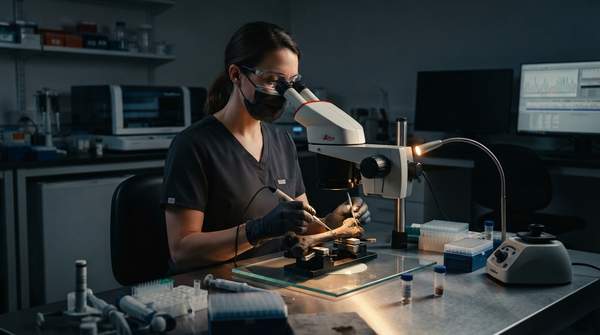
Unraveling Prehistoric Human Migration: The Methodologies of Ancient DNA Analysis
Ancient DNA (aDNA) analysis provides direct genetic evidence to reconstruct prehistoric human migration and population dynamics. The article details specialized methodologies, from laboratory preparation and sequencing to bioinformatic analysis and population genetic statistics, used to overcome aDNA's challenges and uncover past human mobility and admixture.

Global warming fuels record July temperatures and extreme weather
In 2022 alone, extreme heat claimed over 60,000 lives across the WHO European Region .

Insilico Medicine Unveils AI Toolkit for Aging Research
An AI-designed drug, rentosertib, has already demonstrated its capability to reverse predicted biological age by up to six years in a specific aging clock during a Phase 2a trial.

Astronomers Discover New Cosmic Objects: Black Hole Stars
Just 660 million years after the Big Bang, an object dubbed MoM-BH*-1 radiates 100 billion times more energy than any known star, forcing astronomers to rethink how the earliest cosmic giants formed.

Nancy Grace Roman Telescope Poised to Reveal Universe Secrets
In 2026, the Nancy Grace Roman Space Telescope will launch with a field of view 200 times larger than Hubble's infrared capability, promising to map vast swathes of the cosmos with comparable image qu

Scientists Expand Genetic Alphabet From 4 to 8 Letters
E. coli RNA polymerase, the core enzyme of bacterial gene expression, accurately transcribes a synthetic eight-letter DNA alphabet, effectively doubling life's fundamental information capacity, accord

Global warming: UN 1.5C climate target now unattainable
The Earth is now about 1.44°C warmer than it was in the pre-industrial era (1850-1900), according to the UN.

Nancy Grace Roman Space Telescope to Map Billions of Galaxies
Launched on Sunday, NASA's Nancy Grace Roman Space Telescope will survey the sky with a field of view 200 times greater than Hubble's infrared capabilities, promising to map a billion galaxies and dis

Homo floresiensis gait analysis reveals primitive stride
Despite its small stature, Homo erectus left footprints indistinguishable from modern habitually barefoot people, revealing a surprisingly advanced gait 1.

NASA Swift Boost Mission Aims for June Launch to Extend Observatory Life
For the first time, a commercial robotic spacecraft is set to capture and reboost a government satellite not originally designed for servicing, extending the life of NASA's aging Swift Observatory.

Scientists discover multiple new ocean species on deep-sea expeditions
Since last April, the Ocean Census project alone has identified 1,121 previously unknown ocean species, tearing back the veil on a hidden world far beyond our current understanding.

What are cosmic microwave background origins and significance?
The universe's faint, omnipresent glow, known as the cosmic microwave background (CMB), represents the earliest light detectable by humanity, originating approximately 380,000 years after the Big...

High-altitude adaptation reveals surprising human population genetic origins
In the remote Andes, a small indigenous community carries a genetic variant for high-altitude survival, a legacy of their ancestors' migration, which now offers a unique blueprint for human adaptation

7 Breakthrough Imaging Technologies Revolutionizing Research
A single Cryo-EM system, capable of resolving molecular structures down to atomic detail, can cost upwards of $10 million.

AI Data Science Innovations Revolutionizing Research
An AI system from Sakana AI recently generated a hypothesis, designed experiments, and wrote a peer-reviewed scientific paper on its conclusions without any human intervention, according to Forbes .

Scientists Discover New Deep-Sea Species in Indian Ocean Expedition
An expedition near Christmas and Cocos islands in the Indian Ocean has just unveiled 149 previously unknown marine species, alongside a 'Shark Tooth Graveyard' holding 1,000 teeth spanning 22 million

Eocene Forests Faced Warming Like Ours, Offering Climate Change Lessons
In Wyoming's Bighorn Basin, fossil records reveal that during an ancient global warming event 56 million years ago, forests lost a staggering 60% of their canopy, according to The Guardian .

What are AUVs and why do they matter for deep-sea discovery?
In the Clarion-Clipperton Zone, 24 new deep-sea species were recently discovered, a testament to how rapidly advanced submersibles are unveiling Earth's last great frontier.

Private Satellites' AI Powers New Earth Observation Climate Insights
An ambitious initiative in Asia is building one of the world's most high-resolution remote sensing ecosystems, promising to deliver climate insights with exceptional detail, according to Intelligent L

SpaceX rocket stage to crash near moon's Einstein crater
A five-ton piece of a SpaceX Falcon 9 rocket, traveling at 5,400 mph, is expected to collide with the Moon near the crater Einstein on Wednesday, August 5, according to ABCNews and Space.

Top 5 Emerging Sustainable Energy Technologies for 2026
By the end of 2023, China's newly installed renewable energy capacity alone accounted for over 80% of its national total and more than half of the global new capacity, a monumental shift driven by uns

Subglacial Lakes and Aquifers Now Serve as Climate Observatories
Beneath two miles of Antarctic ice, a recently sampled subglacial lake, isolated for millions of years, revealed a thriving, ancient ecosystem.

Astronomers Find Sugar Molecule in Deep Space, Hinting at Life's Origins
In the desolate expanse near our galaxy's supermassive black hole, astronomers have, for the first time, detected erythrulose, a four-carbon sugar molecule crucial to the very origins of life.

Israel tests AI drone technology for rapid wildfire detection
An autonomous drone system, recently tested in Israel, detects wildfires across hundreds of square kilometers within minutes of ignition, pinpointing their location with meter-level accuracy.