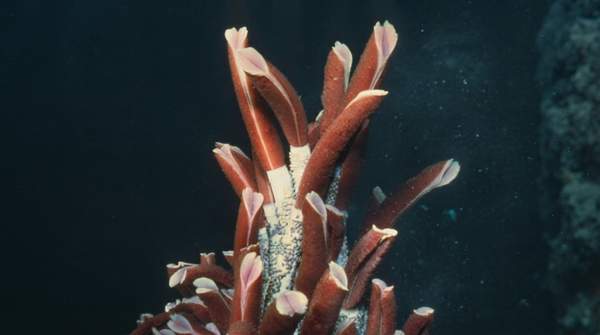
Deep-sea hydrothermal vents host thriving animal communities not because of sunlight, but because of chemosynthesis: microbes convert chemicals from vent fluid—hydrogen sulfide, hydrogen, and carbon dioxide—into food, and everything else in the ecosystem feeds on that output. The giant tube worm Riftia pachyptila has no gut at all; it farms bacteria inside its own body. This article explains how the chemistry works, which microbes do what, and how vent animals survive pressure, heat, and toxic chemicals.
Life in the Abyss: An Introduction to Hydrothermal Vents
Hydrothermal vents are cracks in the seafloor where superheated, mineral-laden fluid escapes from beneath the crust. A research review of vent biology describes their conditions as extreme in every measurable way: pressures up to 420 atmospheres, temperatures swinging from 2–4°C ambient seawater to roughly 400°C at the vent fluid, acidic pH, toxic heavy metals, hydrogen sulfide, and total darkness.
Yet these environments are oases. When the first vent communities were discovered, scientists found entirely new animal species flourishing despite having no access to sunlight, as NOAA's Ocean Exploration program recounts. Since then, similar communities have been documented at vent fields and cold seep sites around the globe. The question is not whether life survives here, but how.
Chemosynthesis: The Engine of Deep-Sea Life
On the surface, plants power food chains through photosynthesis: sunlight drives the conversion of carbon dioxide into sugar. At vents, the same conversion happens without light. The Natural History Museum defines chemosynthesis as a process in which chemical energy converts carbon dioxide into sugar—food—in the complete absence of sunlight.
The chemicals doing the work come from the vent fluid itself. NASA's astrobiology program notes that the heated waters spewing from vents are rich in chemicals that would be toxic to humans but that chemosynthetic microorganisms can convert into energy. Crucially, there is no single chemical pathway: as NOAA's chemosynthesis fact sheet emphasizes, chemosynthesis is defined by multiple distinct reactions rather than one universal route. Sulphur and hydrogen alone can sustain bacterial growth, as the Natural History Museum's Anne (a cited expert) explains—extremophile bacteria have been found to gain their energy from these elements without light or oxygen.