Deep-sea hydrothermal vents change ocean chemistry by running seawater through a sub-seafloor chemical reactor: cold, oxygenated water sinks into fractured oceanic crust, reacts with hot rock near a magma lens, and returns as a fluid stripped of magnesium and sulfate but loaded with hydrogen sulfide, reduced metals, and gases. Microbes then harvest the chemical energy in that fluid, driving elemental cycles of sulfur, iron, and carbon far beyond the vent itself. The result is a globally significant exchange between the ocean and the Earth's crust — one that scientists are still struggling to quantify.
Introduction to Deep-Sea Hydrothermal Vents
Since their discovery in 1977 at mid-ocean ridges, hydrothermal vents have been recognized as among the most biologically and chemically active regions of the deep ocean. The best-studied high-temperature vents occur along mid-ocean ridges at divergent plate boundaries, where they release fluids that are acidic, anoxic, metal-rich, and — strikingly — completely free of magnesium, as documented in classic measurements by Von Damm and colleagues in 1985.
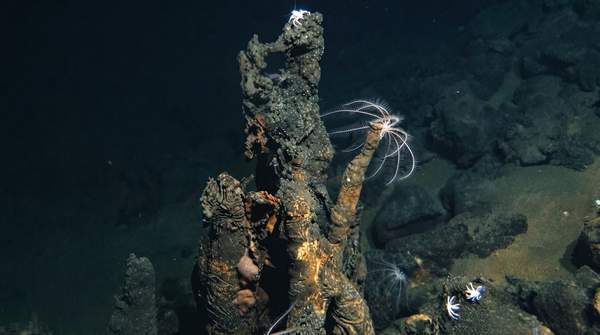
What makes vents geochemically important is not just the spectacle of "black smoker" chimneys, but the fact that they are a two-way chemical pipeline. Seawater goes in; a fundamentally different fluid comes out. As James Holden and co-authors wrote in the journal Oceanography, understanding how vents affect the ocean and global geochemical cycles has been a high scientific priority ever since their discovery, and that understanding continues to deepen through coupled modeling and field sampling.