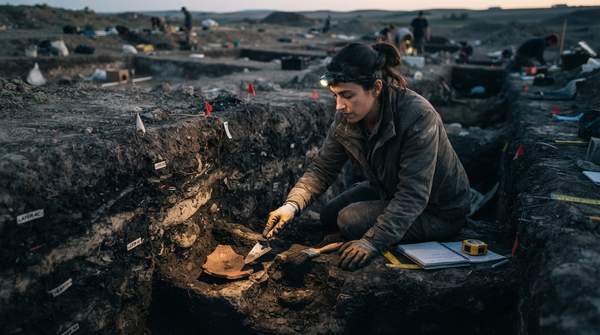
Archaeologists date ancient sites by combining two complementary approaches. Relative dating, built on the principle of stratigraphy, arranges layers and artifacts into a sequence—what is older, what is younger—without assigning any calendar dates. Absolute dating then anchors that sequence in time by measuring physical or chemical properties of materials found within the layers, such as radioactive decay or tree-ring patterns. The result is a calibrated chronology of human occupation.
Introduction: Unlocking the Past Through Archaeological Time
When archaeologists excavate a settlement, they are not simply collecting objects; they are dismantling, layer by layer, a record that took centuries or millennia to accumulate. The central challenge is that most of that record arrives undated. As the U.S. National Park Service explains, archeologists use relative and absolute dating methods together to determine the age of sites, artifacts, and the behaviors they represent—and very few artifacts recovered from a site can be absolutely dated on their own. The intellectual work of dating a site is therefore a two-stage process: first establish order, then establish time.