The single most consequential choice in a wildlife tracking study is not which sensor to buy but which data-retrieval model to accept. If your animal can be recaptured, an onboard-recording bio-logger can deliver large, near-continuous datasets; if it cannot, you need transmitting bio-telemetry or entirely passive methods such as camera traps, acoustic recorders and environmental DNA. Here is how the five major technologies compare on data type, retrieval, and animal impact.
Setting the Stage for Bio-logging Choices
Bio-logging and its sister techniques exist because the most valuable behavioral and ecological data often cannot be obtained through direct observation. Researchers studying animals in remote, dense or hazardous environments need devices that can see what field biologists cannot. A movement-ecology review published in a 2019 journal article notes that ecologists have driven a revolution in bio-logging sensor technology, resulting in accelerometers, magnetic field sensors, gyrometers, temperature and salinity sensors, video cameras and proximity-loggers that let scientists observe the unobservable.
The result is an embarrassment of options, each with distinct operational characters. Choosing among them means asking three questions up front: What kind of data does my question require? How will that data physically reach me? And what cost — in animal welfare, in disturbance, in study design — am I asking the study subject to bear?
Understanding Tag-Based Monitoring: Bio-logging and Bio-telemetry
The Chizé Centre for Biological Studies (CNRS), which operates bio-logging infrastructure, defines bio-logging as attaching onto — or sometimes inserting into — an animal an electronic device that records physical and geochemical parameters over time, letting scientists reconstruct the animal's activity, the environment it travels through, and the interactions between the two.
The critical distinction is where the data goes. Bio-telemetry, a technology that dates to the 1950s and became available for civilian animal tracking through the ARGOS satellite system, transmits data from the device to a satellite or ground station. Bio-logging, by contrast, records data in the device's own memory — meaning data collection is never interrupted by signal loss, and users can assemble large, near-continuous datasets across a wide range of data types.
That continuity comes at a logistical price. As the CNRS team notes, the animal needs to be captured twice: once to deploy the device and once to recover it and the data it contains. Newer bio-loggers blur the line, combining both approaches by transmitting data — or a subset of it — whenever a communication window with a satellite or ground station opens. These hybrid devices reduce the need for recapture and allow longer study durations, though transmission bandwidth and battery life can limit the quantity of data compared with pure onboard recording.
Non-Invasive Monitoring: Camera Traps and Acoustic Devices
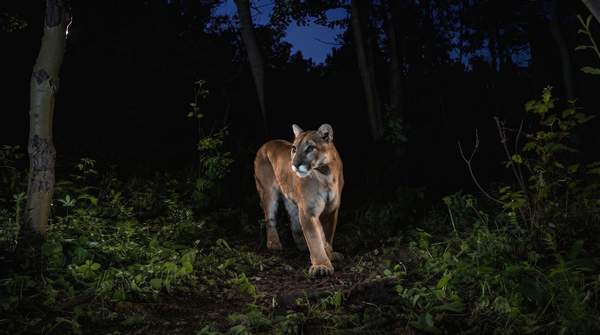
Where tags require capture, passive devices require only presence. Camera traps equipped with motion and heat sensors automatically capture images or video when animals pass, letting researchers monitor species presence, population size and behavior with minimal disturbance. Husson University's overview of conservation technology highlights their value for elusive species, where camera traps have provided data for conservation planning that direct observation never could.
Acoustic monitoring takes the same logic into the auditory realm, capturing the calls and movements of animals in their natural habitats through autonomous recording devices. The approach is especially useful in remote or dense environments, where it allows biodiversity monitoring without disturbing ecosystems; advances in artificial intelligence now speed the analysis of vast acoustic datasets, improving species detection. An Avian Conservation and Ecology study published in 2025 pairs camera traps and autonomous recording units to evaluate and improve species-habitat inferences, illustrating how the two passive methods can be combined rather than chosen between.
Environmental DNA (eDNA): A Modern Approach to Species Detection
Environmental DNA refers to genetic material that animals leave behind in water, soil or air. By sampling and analyzing these traces, researchers can detect species without needing to see or capture them. A systematic review of eDNA substrates for terrestrial animal monitoring describes the approach as non-invasive, cost-effective and highly sensitive for species detection, and emphasizes that substrate choice — soil, water, air or something else — depends on the ecological context and taxonomic focus of each study rather than on any universally "most effective" option.
The method's power is quantifiable. A US Forest Service research team led by Leah Samuels and colleagues compared eDNA sampling, camera trapping and visual encounter surveys for detecting the eastern indigo snake at four sites in the southeastern United States. Of 120 samples collected from locations with confirmed snake presence, 66 amplified — a 55 percent detection rate — with eDNA detectable up to six days after the animal had been present. And World Wildlife Fund reported on a study in which eDNA sampling detected 25 percent more terrestrial mammal species than camera traps, at a fraction of the cost.
Key Trade-offs: Data Quantity, Study Duration, and Animal Welfare
Every tag-based method forces the same balancing act, which the CNRS bio-logging team names the fundamental trade-off: reducing the size and weight of the logger to diminish the impact on the animal, while preserving as much as possible the lifetime of the batteries and the memory size.
The movement-ecology review elaborates that trade-offs also run between the quantity of data collected and the time a tag collects data on an individual, and between the amount of data collected on single animals versus the number of different animals monitored across time and space. Reducing battery consumption extends device life, but also carries implications for tag size and attachment that matter for both optimal study design and animal welfare.
The ethics do not end at the drawing board. The review's authors stress that the ethics of bio-logging remains a major concern both in fitting the device — which often requires capture — and in the effects of carrying it, and they point to improved handling methods, shorter handling times, and even remote tagging as directions in which ecologists can advance welfare methodology.
Comparative Decision Framework for Wildlife Monitoring Technologies
The table below categorizes the five major technologies against four decision criteria — data type, retrieval method and welfare impact — so a researcher can match each option to a concrete scenario: recapture impossible, non-invasive monitoring required, or continuous high-resolution movement data the priority.
| Technology | Primary Data Collected | Data Retrieval Method | Invasiveness / Welfare Impact |
|---|---|---|---|
| Bio-logging tags (onboard recording) | High-resolution movement, physiology and environment: accelerometry, magnetic field, gyrometers, temperature, salinity, video, proximity; near-continuous because signal loss never interrupts recording | Stored on device; animal must be captured twice — once for deployment, once for recovery | Invasive; requires capture and carrying the device. Size, weight and attachment must be minimized for welfare |
| Bio-telemetry tags (remote transmission) | Typically location and environmental or physiological parameters; quantity can be limited by transmission bandwidth and battery compared with onboard recording | Transmitted to satellites (e.g., ARGOS) or ground stations; eliminates recapture, enabling longer studies on hard-to-recapture animals | Invasive; requires capture for fitting and device attachment, with the same size and weight considerations |
| Camera traps / motion sensors | Species presence, population size, behavior via images or video triggered by motion and heat sensors; valuable for elusive species | Stored on device, retrieved by the researcher on site — no animal contact needed | Non-invasive; minimal disturbance to animals |
| Acoustic monitoring | Calls and movements via autonomous recorders; suitable for remote or dense environments; AI accelerates analysis | Stored on recording units, collected by the researcher | Non-invasive; enables biodiversity monitoring without disturbing ecosystems |
| Environmental DNA (eDNA) | Species detection from genetic material in water, soil or air; in one comparison detected 55% of confirmed snake locations and, in another study, 25% more mammal species than camera traps | Collected from the environment by the researcher; no animal contact | Non-invasive; detects species without seeing or capturing them, though detectability decays within days |
Read as a decision map, the table splits cleanly along two axes. Tags — bio-logging or bio-telemetry — are the only options that deliver continuous individual-level movement and physiological data, and they are the only options that require capture and an animal carrying hardware. The three passive methods trade individual-level continuity for scale, low cost and zero contact: camera traps and acoustics for presence and behavior at fixed points, eDNA for rapid, sensitive species detection across whole landscapes, particularly in aquatic environments where traditional surveys are difficult.
Optimizing Research for Conservation: Making Informed Technology Choices
Researchers should select bio-logging and monitoring technologies by carefully balancing the desired data type, data retrieval feasibility, and the potential impact on animal welfare against their specific study objectives and available resources. In practice, that means deciding first whether your question demands an individual animal's continuous story — which points to a tag, and to the CNRS-defined trade-off of shrinking the device while preserving battery and memory — or a population's presence and diversity, which points to passive methods, potentially in combination.
A successful study design will demonstrate data collection that directly addresses research questions while adhering to ethical guidelines and minimizing disturbance to target species. The measurable test is straightforward: before deployment, check whether your chosen method's retrieval route, detection characteristics and welfare profile all survive contact with your field logistics — whether that is a feasible second capture, a satellite link, or eDNA decay within the six-day window documented in the indigo snake study.
Sources
- Optimising the use of bio-loggers for movement ecology research - PMC
- What is Bio-logging? – cebc UMR 7372-en
- Home — Husson University
- Avian Conservation and Ecology — Avian Conservation and Ecology -
- Properties and Limitations of eDNA Substrates for Terrestrial Animal Monitoring - PMC
- Comparison of camera traps, eDNA, and visual encounter surveys for threatened species detection — US Forest Service Research and Development
- Worldwildlife