Atmospheric oxygen, together with its photochemical byproduct ozone, sits at the top of the list of gases astronomers look for when searching distant planets for life, because on Earth its abundance is a direct product of photosynthesis. Yet the same researchers who champion oxygen as a biosignature warn that detecting it is not a discovery of life by itself. Planets without biology can build oxygen-rich atmospheres through several known non-living mechanisms, producing what the field calls false positives. The lesson, drawn from a body of expert reviews, is that a single spectral detection is rarely sufficient: interpreting oxygen requires modeling the whole planetary environment before life becomes the accepted explanation.
The Promise of Oxygen: A Primary Biosignature
Biosignatures, as a 2024 overview by Edward W. Schwieterman and Michaela Leung defines them, are observable features or substances that provide scientific evidence of past or present life. They fall into three broad categories: gaseous biosignatures such as oxygen from photosynthesis and its photolytic byproduct ozone; surface biosignatures such as vegetation and water-based pigments; and temporal biosignatures, meaning seasonal variations in atmospheric gases and surface features. Within this taxonomy, oxygen holds a privileged position.
The reason is Earth's own history. Photosynthesis is the biological source of the oxygen that now dominates our atmosphere, and because oxygen is highly reactive, it does not persist without continuous replenishment. That reactivity is precisely what makes a sustained oxygen detection so tantalizing: something must be producing the gas faster than chemistry destroys it. Atmospheric oxygen and ozone are therefore commonly assumed to be indicators of life, as a study of abiotic oxygen buildup in moist atmospheres published in the Astrophysical Journal notes.
But the assumption is a starting point, not a conclusion. The same Astrophysical Journal paper frames the essential question: under what conditions, and by what processes, can oxygen and ozone be produced without biology? Constraining those processes, its authors argue, will be essential to avoid false positive detections of life—cases where oxygen or ozone is interpreted as a bioindicator despite being produced abiotically.
The Challenge of False Positives: Abiotic Oxygen Mimics
The false positive problem is not hypothetical; it is a lesson the field learned specifically from studying oxygen and ozone. A framework paper on exoplanet biosignature assessment states it bluntly: the extraordinary claim of life should be the hypothesis of last resort, adopted only after all conceivable abiotic alternatives are exhausted. If remote data suggest life, the discovery will always carry some uncertainty, which is why that framework assigns confidence levels and probabilities rather than verdicts.
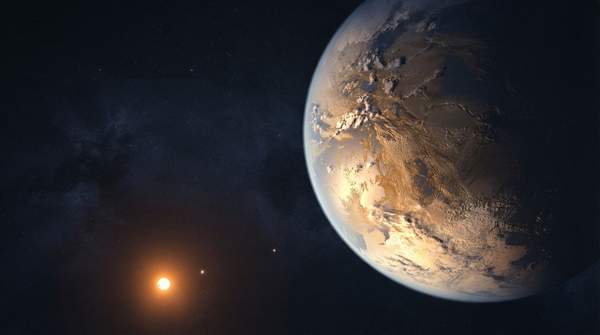
Several abiotic mechanisms are already on the books. One well-studied route involves planets orbiting M dwarfs. Because habitable planets around these small stars orbit very close to their hosts, they receive relatively higher XUV fluxes than Earth does, and earlier work raised the possibility that atmospheric oxygen could become a false positive on such worlds through photodissociation of water molecules in the upper atmosphere—though that process is effective only if the cold trap mechanism fails to keep water vapor out of the upper atmosphere.
A more recently identified mechanism comes from a team led by Norio Narita, writing in Scientific Reports. They showed that titanium (IV) oxide—titania—can produce abiotic oxygen from liquid water under near ultraviolet light on a planet's surface, a photochemical pathway previously unconsidered. Their analysis suggests titania may produce abiotic oxygen atmospheres on habitable exoplanets. Notably, they also calculate that significant oxygen production by this route did not occur over Earth's roughly four-billion-year history, constraining Earth's effective titania-active surface area to much less than about 250 square kilometers—evidence that the mechanism's strength depends heavily on planetary surface conditions.
Oxygen as a Biosignature: Biological Origins vs. Abiotic Mimics
The table below assembles the comparison at the heart of the false positive problem: what oxygen's biological source is, which specific non-biological processes can mimic it, and what contextual evidence scientists use to tell the two apart.
<
| Aspect | What the Evidence Shows | Why It Matters for Interpretation |
|---|---|---|
| Biosignature | Atmospheric oxygen (O2) and its photochemical byproduct ozone (O3) are commonly assumed indicators of life. | The assumption is a starting point that requires rigorous verification, not a detection verdict. |
| Potential biological source | Photosynthesis is the biological source of Earth's abundant atmospheric oxygen. | The rise of abundant oxygen can be delayed by geological sinks that counter biological production—producing a false negative, as happened on early Earth. |
| Abiotic mimic: water photodissociation | On planets around M dwarfs, strong XUV irradiation can split water in the upper atmosphere, a route earlier studies identified as a possible oxygen false positive. | Effective only if the cold trap fails to keep water vapor out of the upper atmosphere—a testable atmospheric condition. |
| Abiotic mimic: titania photocatalysis | Titanium (IV) oxide can produce abiotic oxygen from liquid water under near ultraviolet light, per Narita and colleagues. | Titania may produce abiotic oxygen atmospheres on habitable exoplanets; Earth's own history bounds its effect here. |
| Contextual clues to distinguish | Interpretation requires the planetary environment, host star properties, geological activity, other atmospheric gases, and atmospheric thermodynamic stability. | This holistic assessment helps evaluate the likelihood of the data and rule out false positives. |
Planetary Context: The Key to Disentangling Life from Non-Life
Why does context carry so much weight? Because, as the Schwieterman and Leung overview emphasizes, most potential biosignatures can also be produced through abiotic processes under certain conditions. Distinguishing true biosignatures requires considering the entire planetary context: the planetary environment of temperature, pressure, and atmospheric composition; the host star's properties and radiation output; the planet's geological activity; the presence of other atmospheric gases; and the thermodynamic stability of the atmosphere.
The assessment framework formalizes this by grading confidence. Its highest tier—a very likely inhabited exoplanet—requires multiple lines of evidence and a posterior probability of life, given the data and context, of at least 90 percent. Its illustrative candidate is not an oxygen detection alone but a habitable-zone planet very similar to Earth showing coexisting atmospheric O2, CH4, N2O, and CO2 along with evidence of a liquid water ocean, precisely because an abiotic system would be very unlikely to mimic all of those data at once.
Context also works in the other direction. As Christopher Meadows and colleagues detail in their 2018 review, the long delay between the evolution of oxygen-producing photosynthesis and the subsequent rise of abundant oxygen in Earth's atmosphere was caused by geological sinks that countered biological production—ultimately a false negative. Understanding a planetary environment, they argue, is essential both for spotting characteristics that might hide a biosignature and for judging the likelihood of false positives. In practice, gas abundances derived from spectra feed into photochemical–climate models that predict the surface fluxes needed to sustain the observed atmosphere, and quantifying those fluxes may aid in distinguishing true biosignatures from abiotic processes.
Beyond Oxygen: The Broader Search for Biosignatures
Oxygen dominates the discussion because its biological origin on Earth is unambiguous and its spectral features are observable, but it is one entry in a wider portfolio. The same reviews that catalog oxygen also point to surface biosignatures such as vegetation-like pigments and to temporal biosignatures—seasonal variations in gases and surface features that a static abiotic process would struggle to reproduce. These categories matter less as independent smoking guns than as complementary lines of evidence.
That complementarity is the field's real operating principle. A gas that is ambiguous alone becomes more informative alongside a surface feature, a seasonal cycle, or an atmospheric composition that an abiotic scenario cannot easily reconstruct. The search for life on exoplanets is therefore less a single measurement than an argument assembled from many measurements, each of which narrows the space of non-living explanations.
Interpreting Biosignatures: A Call for Comprehensive Planetary Context
When evaluating potential biosignatures like oxygen, scientists must exhaust all conceivable abiotic alternatives and integrate diverse planetary contextual data before concluding the presence of life. That is the discipline the framework paper imposes—life as the hypothesis of last resort, assigned a probability rather than proclaimed—and it is why titania photocatalysis, water photodissociation, and geological sinks are treated as serious rivals to biology rather than footnotes. The measurable indicator of a credible claim is the publication of a biosignature detection accompanied by a detailed planetary model that rigorously rules out known abiotic false positives and considers the host star's properties and atmospheric composition. Until a detection clears that bar, oxygen remains the most promising clue we have—and, deliberately, the most cautiously interpreted.
Sources
- Exoplanet Biosignatures: A Framework for Their Assessment - PMC
- Buildup of Abiotic Oxygen and Ozone in Moist Atmospheres of Temperate Terrestrial… — Iopscience
- Titania may produce abiotic oxygen atmospheres on habitable exoplanets - Scientific Reports — Nature
- An Overview of Exoplanet Biosignatures — alphaXiv
- Reinhard